You paste the job description into ChatGPT, ask for a cover letter, and eight seconds later you have one. It opens with "I was excited to come across this opportunity," cites your "proven track record," and closes with enthusiasm about "contributing to the team's continued success." It reads fine. Then you scroll LinkedIn and find a recruiter posting screenshots of her inbox, forty letters that open with the same sentence yours does, and you quietly close the tab.
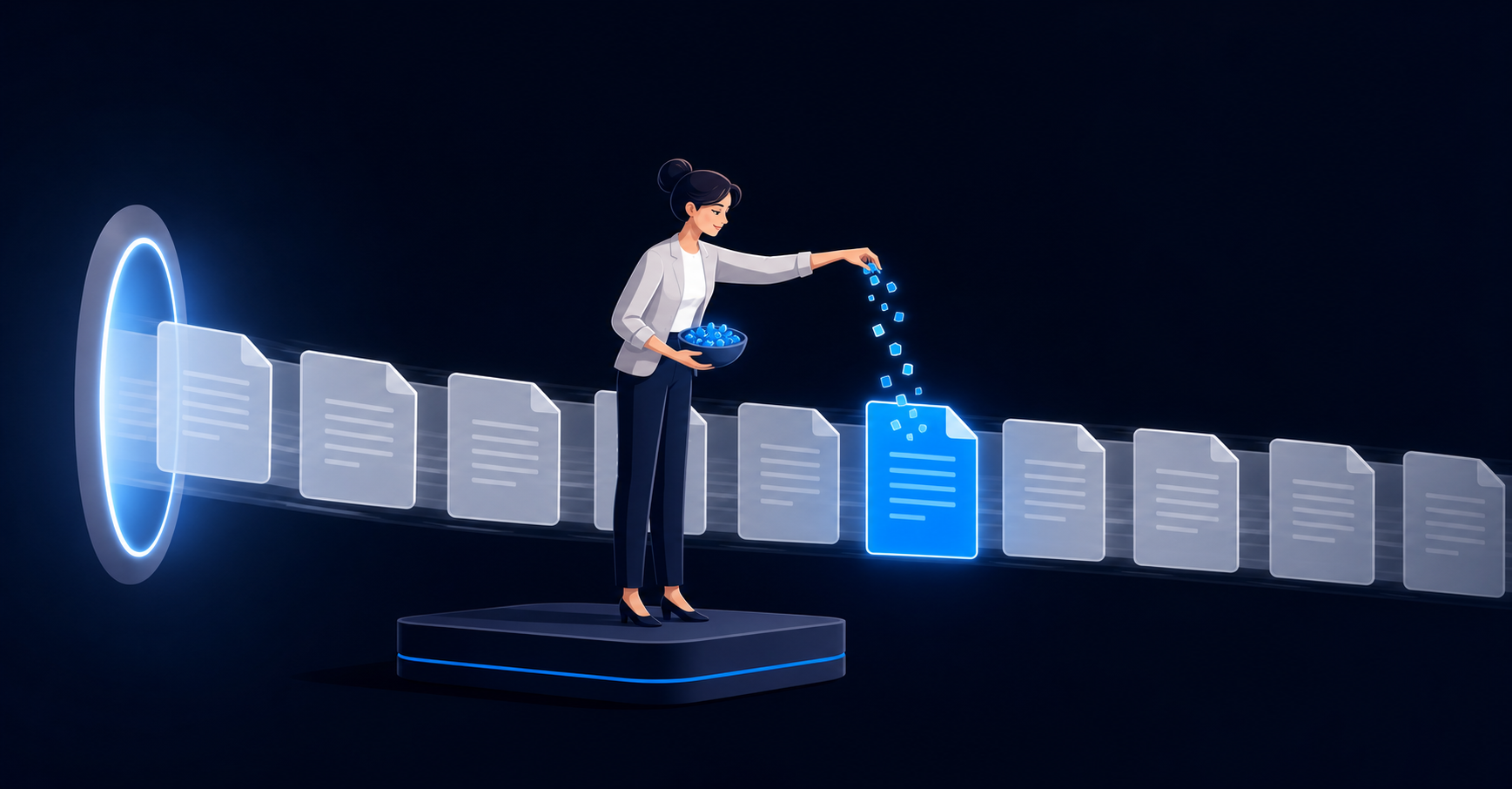
The easy conclusion is that AI ruins applications and recruiters can smell it from across the room. The accurate conclusion is less comfortable: the model did exactly what you asked. You handed it a job description and nothing else, so it wrote what anyone on earth applying to that job would write. AI doesn't make you sound like a bot; an empty input does. Given nothing of you to work with, the model fills the silence with the statistical average of every cover letter ever written, and the average of everything sounds like no one.
What recruiters are actually detecting
Nobody screening applications is running your letter through an AI detector. What they notice, after the two hundredth submission, is the absence of evidence. A letter written from a real career has texture: the support queue that was three weeks behind, the launch that almost died in legal review, the number that went from 4 percent to 11. A letter written from a job posting has adjectives. "Passionate," "results driven," "collaborative" are what a language model reaches for when it knows the role but not the person, and a recruiter reads that flatness as bot even when a human typed every word.
That's worth sitting with, because it means the inverse is also true. Output grounded in your specific evidence doesn't read as AI, regardless of what drafted the first pass. The question that decides whether you sound like a bot isn't "did AI write this?" It's "did the thing that wrote this know anything real about me?"
The fix is the input, not the prompt
Most people respond to robotic output by tinkering with instructions: write in a conversational tone, avoid clichés, sound human. That's repainting the wallpaper. The model still can't cite work it has never seen, so it produces the same emptiness in a more casual register, which is arguably worse.
The real fix happens before you ever mention a specific job. Get your raw material into a form AI can use: the actual accomplishments with actual numbers, the stories behind them, the context of what was hard and what you traded off to get it done. This is slow, and it's the step nearly everyone skips, which is exactly why nearly everyone's AI output is interchangeable. Once that record exists, the model's job transforms. It stops inventing plausible sentences about a stranger and starts selecting the strongest evidence you have for the problem this posting describes. Invention is where the bot voice comes from, and selection is where your own voice survives.
Where AI belongs in the application itself
With the foundation in place, AI earns a role at every step of applying, and the order matters. Start with fit, before you spend an evening on an application: does your evidence actually hit this role's problems, and where are the gaps? An honest read here kills weak applications early, which is a feature, since ten grounded applications beat sixty sprayed ones.
Then tailoring. The resume version of you that fits this job already exists inside your history; AI is good at finding it, reordering your bullets so the most relevant proof leads, and swapping your generic nouns for the posting's terms without touching the sentences that sound like you. The cover letter comes next, and it should be built as an argument, your three strongest pieces of evidence connected to their stated pain, rather than a summary of enthusiasm. Interview prep closes the loop, because everything the AI claimed on your behalf is something you'll need to say out loud to a person who can ask follow up questions.
That last point is the test that governs all of it. Read every AI drafted line and ask whether you could defend it for five minutes in a room. Lines that pass were built from your real evidence, and lines that fail were invented, no matter how polished they look on the page.
The work that makes AI worth using
The job seekers getting interviews with AI assistance aren't hiding the assistance, and they aren't better prompt writers than you. They did the slow work once, documenting what they've actually done in enough detail that a machine can argue on their behalf, and now every application draws on that record instead of starting from a blank page and a posting. The bot voice was never really about the bot. It's what any writer sounds like with nothing to say, and the moment you give the machine something true, it stops talking like everyone and starts talking like you.
This is the entire design of Prism Tree: you build a Career Brain, a structured record of your experiences, accomplishments, and stories, and every output is generated from that evidence instead of from the job posting. Fit analysis tells you whether to apply, then tailored resumes, cover letters, and interview prep all draw on your documented history, in your voice. You bring your own AI key, so the intelligence is yours end to end. Build your Career Brain at app.prismtree.ai and make your next application the first one that sounds like you.